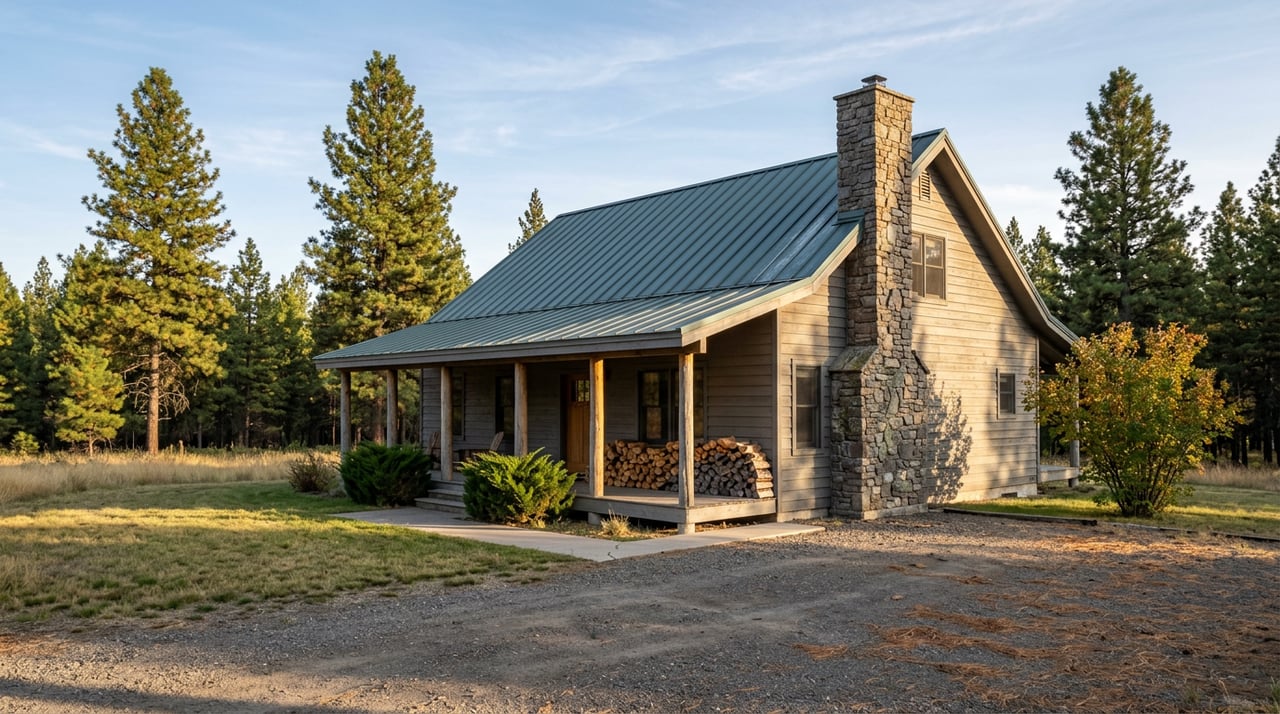
A seller in Red Feather Lakes can fill out every box on the state disclosure form, tell the truth about every hailstorm and every insurance claim, and still watch a deal die two weeks before closing. Not because of anything written down. Because a lender called and said no carrier would write a policy on the house, and without a bound policy, there is no funded mortgage.
That gap between "fully disclosed" and "fully insurable" is the real story in Red Feather Lakes this year. Three separate pieces of Colorado law changed, and none of them touch the actual choke point. A new local program does, and it launched at almost exactly the same moment.
Three Changes to Colorado Real Estate Rules
Colorado's paperwork got heavier this year, on a predictable schedule.
| Date | What changed | Who it touches |
|---|---|---|
| January 1, 2026 | The Colorado Real Estate Commission's new Seller's Property Disclosure form, SPD19, became mandatory. It runs 14 pages, and Section A asks directly about damage from hail, wind, fire, or flood while Section R asks about any property insurance claim ever submitted, paid or not. | Every residential seller in the state |
| Colorado adopted its first statewide wildfire building code. | ||
| July 1, 2026 | PropCash reports that HB25-1182 took effect, requiring insurers to disclose a homeowner's wildfire risk score and to credit documented mitigation work when setting or renewing a policy, with an appeal process attached. | Anyone shopping for or renewing wildfire-zone coverage |
None of these three changes make a Red Feather Lakes home easier to insure on their own. They make the paperwork trail longer and, for the first time, give a homeowner a legal hook to push back when an insurer's risk model gets it wrong.
The Bottleneck Sits With the Lender, Not the Buyer
What the form cannot do is make State Farm or Allstate willing to write a new policy on a property with heavy timber to the eaves and a quarter-mile gravel driveway.
That is a financing problem wearing a disclosure costume. A conventional lender will not fund without proof of a bound homeowners policy. If the buyer's insurance search stalls, the mortgage stalls with it, regardless of how clean the SPD19 looked at contract signing. Sellers who treat the disclosure form as the finish line are solving the wrong problem.
What a Red Feather Lakes Home Looks Like to an Underwriter
Carriers do not guess at wildfire risk. Most run an address through a model that scores the fuel load around the structure, the slope it sits on, and how quickly a fire crew could reach it. The factors that push a Colorado address into the declined pile are specific: heavy timber close to the house, a steep or single-access driveway, and distance from a staffed fire station.
Read that list against a typical Red Feather Lakes property. Private well and septic systems are standard here, not the exception. Many parcels sit on long single-lane driveways cut through stands of ponderosa pine and lodgepole. Some communities, including parts of Crystal Lakes, carry a road association rather than a municipal road department, which means snow removal and access maintenance depend on a private HOA rather than a county plow schedule. None of that shows up as a defect on a disclosure form. All of it shows up on an underwriter's risk model.
The Local Counter-Move: HIZ MAP
This is where the timing gets interesting. In June 2026, Larimer County and the Coalition for the Poudre River Watershed opened applications for the Home Ignition Zone Mitigation Assistance Program, known locally as HIZ MAP. It is the newest piece of the Red Feather Lakes Area Wildfire Defense Project, funded through a USDA Community Wildfire Defense Grant and co-managed by the Coalition and the Larimer County Office of Emergency Management.
Eligible parcels sit in Cherokee Meadows, Crystal Lakes, Glacier View, and the broader Poudre Canyon area. Eligible homeowners can receive contractor-coordinated defensible-space work worth up to $4,000, starting with a required Home Ignition Zone Assessment through the local fire district. Selection is not automatic. Larimer County has been clear that submitting an application does not guarantee funding, and homeowners whose parcels are chosen sign a right-of-entry form before crews start. The broader project runs through 2029.
What it covers is specific, and worth knowing before you assume it solves everything:
- Vegetation management and defensible-space clearing around the structure
- Roadside fuel treatments in participating communities
- A free Home Ignition Zone Assessment, available even to homeowners whose parcel isn't selected for funded work
What it does not cover:
- Roofing, vents, screens, gutters, or any building-related hardening
- Guaranteed acceptance, since applications are prioritized rather than automatically approved
Why the Sequence Favors Sellers Who Move Now
HB25-1182 requires insurers to credit documented mitigation starting the same summer HIZ MAP opened its doors. That is not a coincidence a seller should ignore. A completed HIZ Assessment, even one that never receives funded contractor work, produces exactly the kind of dated documentation an insurer now has to weigh under the new law. A seller who books that assessment before listing walks into insurance shopping season with paperwork a buyer's carrier can actually use.
The backstop still matters, and it is worth understanding rather than assuming it solves the problem. The Colorado FAIR Plan exists for properties every standard carrier has declined, but it caps coverage at $750,000, pays actual cash value rather than replacement cost, and requires proof that three insurers turned the property down first. Fannie Mae's own selling guide treats a FAIR Plan policy as acceptable only when nothing else is available. It is a floor, not a strategy, and pricing a listing around it should be a last resort rather than a plan.
A Realistic Timeline If You're Selling or Buying This Fall
- Schedule a Home Ignition Zone Assessment before you list. It is free, it is the required first step for HIZ MAP eligibility, and it creates the dated documentation HB25-1182 now requires insurers to consider.
- Apply for HIZ MAP early if your parcel sits in an eligible community. Selection is prioritized, not guaranteed, so applying in September rather than December matters.
- Get insurance quotes from at least two or three carriers before you set a list price. A price built on last year's premium assumption invites a renegotiation in week three of escrow.
- Keep dated photos and receipts for any mitigation work. SPD19's Section A and Section R both ask about casualty damage and insurance claims, and a documented history of defensible-space work strengthens both your disclosure and a future buyer's insurance application.
FAQ
Does HIZ MAP pay for a new roof or fire-resistant vents? No. The program funds defensible-space and vegetation-management work only. Home-hardening upgrades like roofing, vents, and siding fall outside its scope.
What if my community applies for HIZ MAP and doesn't get selected? The Home Ignition Zone Assessment itself still has value. It is free, it documents your property's current risk factors, and it gives you paperwork to bring to an insurer even without the funded contractor work attached.
Does the Colorado FAIR Plan mean my house is uninsurable through normal channels? Not necessarily, and it is not a substitute for trying standard carriers first. The FAIR Plan requires proof that three insurers already declined coverage, caps payouts at $750,000, and pays actual cash value rather than full replacement cost. Treat it as the last option, not the first quote.
Red Feather Lakes real estate has always asked more of the people who work in it, because the mountains do not run on the same clock as the valley. This year that difference shows up in the paperwork stack as much as the drive time. If you are weighing a sale or a purchase up here and want a plan that accounts for the insurance timeline before it becomes the problem, reach out to Meagan Griesel for a custom marketing plan built around what this market actually requires right now.
This article is general information, not legal, tax or financial advice. Consult a qualified professional about your situation.