If you have been watching Downtown Loveland listings this year, you have probably seen the headline number: the median sale price is up 45.7 percent compared to the same three months last year, landing at $623,000 for the period ending April 2026. That looks like a neighborhood on fire.
Then there's the number sitting right next to it that nobody screenshots. The median price per square foot in that same window actually fell 8.2 percent, down to $359. Same neighborhood, same three months, two numbers pointing in opposite directions.
That contradiction is not a data error. It is the most useful thing you can learn about Downtown Loveland before you write an offer or price a listing here, because it tells you the market did not get more valuable this year. It got a different mix of buildings selling in it.
Two numbers, one neighborhood, and a citywide comparison that makes it obvious
Compare Downtown Loveland to Loveland as a whole over the identical three-month window ending April 2026. Citywide, the median sale price rose a modest 1.0 percent to $490,000, and the price per square foot rose right along with it, up 7.4 percent to $270. That is what a market looks like when demand and value are moving together. Downtown decoupled from that pattern entirely.
| Area (3 months ending April 2026) | Median sale price | YoY change | Median $/sqft | YoY change |
|---|---|---|---|---|
| Downtown Loveland | $623,000 | +45.7% | $359 | -8.2% |
| Loveland (citywide) | $490,000 | +1.0% | $270 | +7.4% |
When the median price and the per-square-foot price move in opposite directions inside the same three months, the explanation is almost never "the market repriced." It is that the composition of what sold changed. A handful of larger, unusual, or higher-total-price properties can drag a median up even while the typical square foot of housing stock is trading flat or softer.
What's actually in that mix
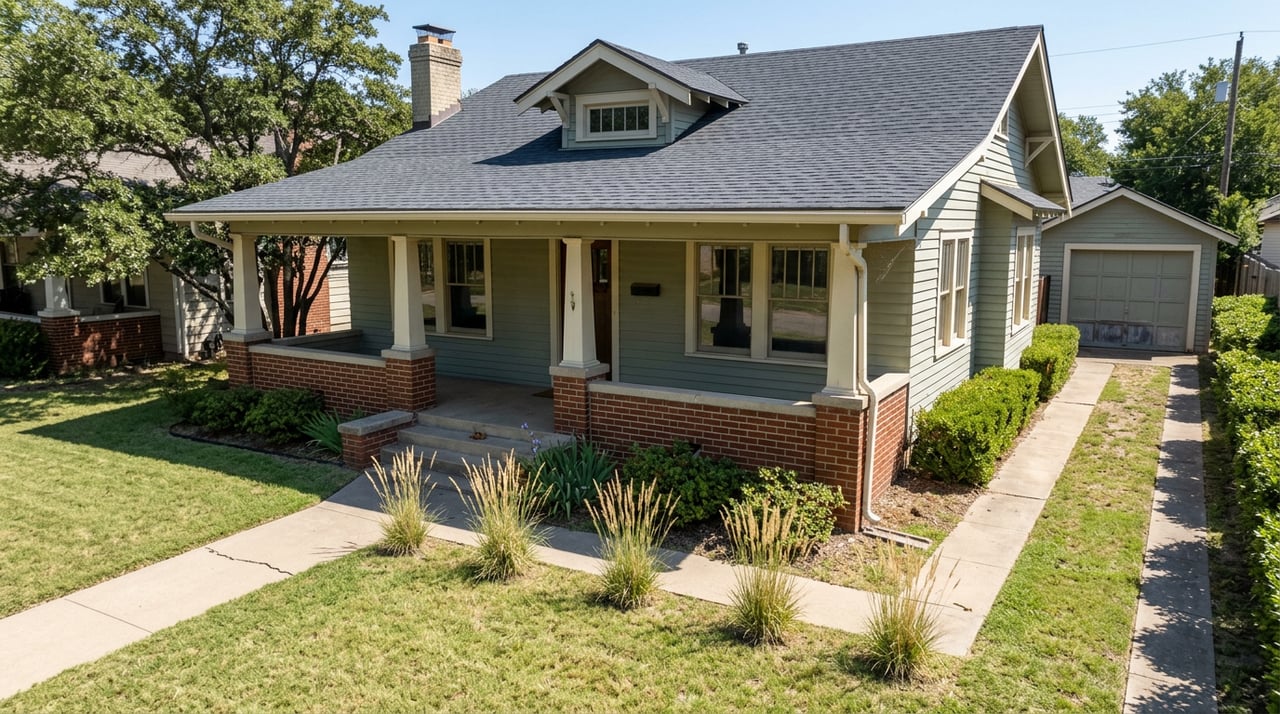
Walk the current inventory in Downtown Loveland and you can see the mix shift in plain sight. On one end you have small, century-old housing stock: a 1910 two-bedroom, one-bath home near 12th and Cleveland at just over 800 square feet, or a 1919 ranch bungalow listed as move-in ready. These are the properties that set the per-square-foot baseline, and they are not commanding a premium this year.
On the other end sit properties that carry a much higher total price tag without necessarily commanding a higher rate per foot, and they are the ones capable of moving a median. One current listing on North Garfield Avenue is a former church converted into a five-bedroom, three-bath residence. Because of a 2007 annexation, it has to be sold together with a neighboring parcel, and the combined listing price is $1,075,000. That is exactly the kind of transaction that pulls a three-month median sharply upward without telling you anything about what a typical downtown square foot is worth. Add in projects like The Collection, marketed as a downtown condominium project built around historical architecture and a prime location, and you get more high-total-price transactions layered into a small sample of downtown sales, which is all it takes to swing a median in a market this size.
This is the part sellers need to sit with before they price off the headline number. If your home is a straightforward 1,400-square-foot bungalow, the 45.7 percent figure is not your comp. Your comp is the $359 per square foot median, and that number just moved the opposite direction.
Why The Foundry changed the story around downtown, not the value inside it
Part of why buyers now expect downtown Loveland to carry a premium traces back to a specific development. The Foundry, a $76 million public-private project built across three city blocks near First and Cleveland, brought Patina Flats, a pair of mixed-use apartment buildings totaling 155 units, a seven-screen, 625-seat MetroLux Dine-In Theatre, a TownePlace Suites by Marriott, and a 460-stall parking garage into the heart of downtown. It gave Loveland something it had not had in the area between downtown and Centerra for two decades: a hotel, and with it a reason for out-of-town visitors and Estes Park-bound travelers to stop and spend time downtown rather than pass through.
That kind of anchor development changes what people expect the surrounding blocks to be worth. It does not automatically raise the resale value of the 1910 bungalow three streets over. New construction and commercial investment near a historic core tend to lift buyer interest and total transaction prices for the handful of properties adjacent to or comparable to the new development, while the older residential stock a few blocks out continues to trade on its own fundamentals, which is a meaningful part of why the per-square-foot figure for downtown as a whole did not follow the median upward.
The historic label that isn't actually restricting most of downtown
Here is the friction that catches buyers off guard once they are further into the process, and it runs in the opposite direction from what most people assume. Buyers shopping "historic Downtown Loveland" often expect every pre-1930s property to come wrapped in design review and renovation restrictions. In reality, Loveland's Historic Register currently includes just 77 properties organized into four historic districts, and participation is entirely voluntary. Property owners who choose not to join a Loveland Historic District are excluded from it, according to the City's own historic preservation FAQ.
That distinction matters for what you can and cannot do with a property after closing. Only landmark properties are subject to Historic Preservation Commission review, and even then the oversight is narrower than most people expect:
- The Commission reviews exterior alterations, repairs, rehabilitation, and new construction through an Alteration Certificate process, evaluated against the Secretary of Interior Standards.
- It has no oversight over routine maintenance, interior modifications, landscaping, low fences or walls, or paint color. Loveland's ordinance does not regulate paint choices at all.
- Landmark designation is a four-step, 60 to 90 day voluntary nomination process, not something imposed on a buyer after purchase.
The part sellers and investors tend to miss is that landmark status is a financial upside, not a limitation. Properties on the Loveland Historic Register can qualify for state and federal tax credits, a Permit Fee Waiver program, and the city's zero-interest Landmark Rehabilitation Loan program for owners rehabilitating a designated structure. If you are evaluating a downtown property and assuming its age automatically caps your renovation options, check whether it is actually one of the 77 landmarked addresses first. Most old downtown homes are not, which means your remodel timeline runs through the standard building permit process rather than a preservation review, and if the home is landmarked, the incentives on the table are worth pricing into your renovation budget rather than treating as a constraint.
What this means depending on which side of the transaction you're on
If you are buying in Downtown Loveland right now, do not anchor your offer to the 45.7 percent median jump. Anchor it to the per-square-foot comps for properties genuinely similar in age, size, and condition to the one you are considering, and ask directly whether any nearby comparable sale involved a combined parcel, a conversion, or new construction that would inflate its total price without reflecting typical value per foot.
If you are selling an older downtown bungalow or duplex, the softer per-square-foot figure is not a reason to panic. It reflects the mix of what has closed recently, not a verdict on your specific property, and a well-staged, well-marketed listing in a walkable downtown location still competes on its own terms. It does mean your pricing strategy should be built from comparable square footage and condition rather than the neighborhood-wide median headline.
And if you are weighing whether to pursue landmark status on a property you already own or are about to buy, the tax credit, fee waiver, and zero-interest loan programs are worth a real conversation before you assume historic designation will slow you down.
A few questions worth asking before you act
Does every home in Downtown Loveland fall under historic preservation rules? No. Only the 77 properties formally listed on the Loveland Historic Register across four historic districts are subject to Historic Preservation Commission review, and joining the register is voluntary.
Will landmark status hurt my resale value or limit what I can do with my home? The City's own guidance states the opposite is more often true. Landmark status can unlock tax credits, a permit fee waiver, and a zero-interest rehabilitation loan program, and the Commission does not regulate interior work, routine maintenance, or paint color.
Why did the median price rise so much more than the per-square-foot price? Because a small number of higher-total-price transactions, including conversions and multi-parcel sales, can pull a three-month median upward in a low-volume downtown market without reflecting what typical square footage is trading for.
Downtown Loveland's numbers this year are a reminder that a median price tells you what happened to sell, not what your specific home or purchase is worth. If you want a pricing or offer strategy built on the comps that actually match your property, rather than a headline percentage, Meagan Griesel can walk through the current downtown inventory with you block by block and build a plan around what your money actually buys.